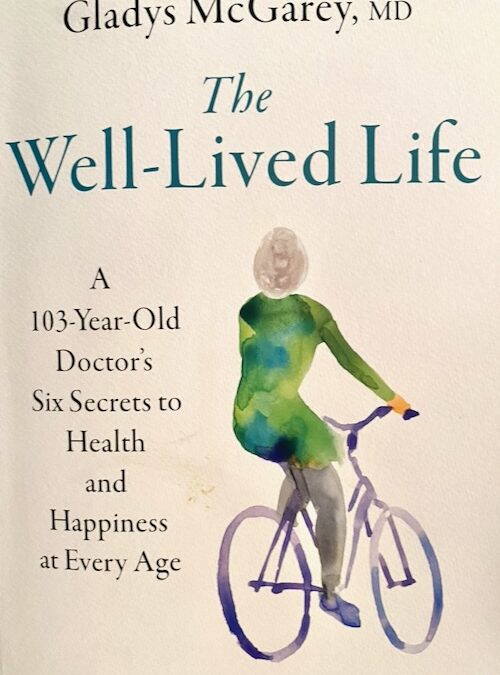
The Well-Lived Life by Gladys McGarey, MD.
Thanks to someone in my development I found in our library the book by someone known as the Mother of Holistic Medicine and she was a doozy!
Her work parallels that of my other great teachers in my life such as Dr Aminah Raheem whose first book Soul Return is a compendium of knowledge for understanding the world and healing and similarly Dr Fritz Smith ’s book Inner Bridges, Dr Milton Trager’s Mentastics, AlanaRubenfeld,Rammurti S. Mishra,Helen Palmer, Carole Kammen, and more!
The Well-Lived Life: A 103-Year-Old Doctor’s Six Secrets to Health and Happiness at Every Age, by Gladys McGarey, MD, Atria, Simon & Schuster, NY 2023.
Holistic Medicine
“Most people think that the role of medicine is simply to promote physical well-being through putting a stop to whatever ails us. Yet teh greater aim is to create a suitably healthy environment — the body— in which the soul can fulfill its purpose.” pg 2 She goes on,”
Each of us came here to do something. And as I see it, true health has nothing to do with diagnosing a disease or prolonging life just for the sake of it; it’s about finding out who we are, paying attention to how we’re called to grow and change, and listening to what makes our heart sing.”
This perspective reflects my larger philosophy: that each individual is part of a greater whole. Just as all of the cells in our body work together to sustain life, all living things work together to create the universe we live in. Each of us is therefore both unique and essential.”
“To understand this broader and more complete view of illness and healing-and of life itself-we need to understand how well-being really works. Contrary to what the medical establishment believes, doctors don’t heal patients; only patients can heal themselves. As doctors we apply skill, knowledge, and ingenuity to treating our patients. We care deeply about people, and we funnel that compassion into our work. This is our sacred role on Earth. Yet ultimately, the best doctors know that healing comes from within,”
Her parents were osteopathic physicians and she was exposed to alternative views on health. she”began to research and discuss ideas that were cutting edge in the 1950’s: the thought that we are souls having a human experience, that some part of us is interconnected with other people, and that we come here as part of a personal and collective mission of growth and healing.”
She and her husband Bill “cofounded the American Holistic Medical Association in 1978 with the goal of bringing a holistic understanding—one that unites body, mind, and spirit—to modern Western medicine.”
pg 3 The term holistic medicine refers not to the strategy but to the approach. It’s about treating the whole patient, not just the disease. It’s about seeing each individual as a complete and complex being, one with a unique set of physical, psychological, and spiritual characteristics, as well as personal set of goals to complete in his or her lifetime. The word holistic combines whole and holy, not is a specifically religious sense but in a way that deeply respects the perfection of each human should and sees the body as an instrument that assists the soul in its tasks. Diseases and symptoms—from simple aches and pains to metastatic cancer—are also part of that perfect design. by showing us where the body is hurt, they show us precisely where the soul needs to work next.”
Soul Work/Purpose
“My patients don’t just come to me to discuss only their physical challenges but their emotional and spiritual challenges too. Each of us is a complex ecosystem of thoughts, feelings, beliefs, and sensations, all of which play into our state of health. I’m interested in helping them see their current distress in the context of the greater journey their soul is undertaking.”
“Life’s challenges point us to the part of our soul that is ready to transform. An acute form of suffering is sure to get our attention. It screams, “Wake Up! Pay Attention! You have work to do!” when we approach our own suffering with curiosity, asking what it may have to teach us, it takes on a new meaning.
pg 4 True health is about living with the world around us as an engaged, participatory experience. It’s about cooperating with the living force within us: our will, our desire to be here and to share our gifts with the world. Our willingness to do so becomes our sense of purpose, and once we have that, our souls can be healthy in any state.”
pg 5 “Your health and vitality—and yes, your purpose and your happiness, as well—depend on creating a doctor-patient relationship with your own self where you are listening closely to what feeds you and brings you joy, as well as prescribing, for yourself, the healing you most need.”
“To be truly alive, we must find the life force within ourselves and direct our energy toward it. …to face everything in life and engage with it…a joyful, participatory engagement that extends to every breath and moment….finding our willingness and our positivity to keep dancing no matter what life throws our way. When life gets tough, we don’t drag our feet; instead, we become curious and we engage even more. Even in the depths of our challenge, we still have access to gratitude.”
“Aligning with the life energy within”
“closer to soul health…reconnected with reason for living and live well”
Love
pg 9 She saw Ghandi when she was a child traveling by train through India. Looking through the window she “saw love emanating from his whole being. the love of that man will never leave me. He looked at me with an unforgettable love—one that recognized my very soul.
If I could give you one thing right now, it would be that same unforgettable love, the kind that recognizes and accepts everything that you are.That love carries hope for the future. It carries the meaning of many lessons, giving purpose to impossible struggle, signaling the turning point when the force of life swells up and pushes us into a new paradigm.
pg 17 Each of us is here for a reason, to learn and grow and to give our gifts. The we are able to do so, we’re filled with the creative life energy that I call the “juice.”
The juice is our reason for living. It’s our fulfillment, our joy. It’s what happens when life is activated by love. It’s the energy we get from the things that matter and mean something to us. Each of us is here to connect with our unique gifts; thesis what activates our desire to be alive.
pg 18 We’re all called to find our juice through our daily contribution to the world.
Being juiced doesn’t ensure perfect health, running out or losing our juice is often a major obstacle to feeling good. for some our juice seems to run out. This can be a shocking and notable experience. But it can be subtler like a car sputtering out of gas.
pg 25 Lives filled with juice become lives filled with purpose. That has a profound effect on our mental health and physical as well. the University of Michigan health and Retirement Study have observed a link between a high sense of purpose and decreased mortality in adults over fifty. Purpose has been found to reduce the risk of cardiovascular events and to prevent the worst effects of Alzheimers disease. There is also evidence linking volunteerism with decreased risk of death—not to mention a stronger sense of well-being. this suggests that living with purpose can actually help us to live longer—and better.”
“And the joy it brings to our lives will ripple out to the world around us. —we consider a soul’s well-being as an aspect of the world’s well-being. We improve the health of the world when we tend to our souls and our hearts, because we all fit together.”
Pg 42 Practice: Finding Your Juice exercise:
1) Gently put your hand on your heart. Just rest, feel th warmth of your hand, the subtle movement of your heart beating. This is where your soul lives. Whenever you feel out of alignment with life, move your hand back to your heart.
2) Ask your heart, “What do you love?” See how your answer evolves as yo ask the question over and over.
3) Hand on heart; think back to a time when you felt a sense of purpose.
4) Think back to your childhood. Consider your earliest memories of joy and satisfaction. What were you doing? Who were yo ubeing? What made your heart sing? What made you giddy with joy? Invite your unconscious to tell you when it is ready It knows.
5) Feel a sense of meaning attached to these memories. What did yo really love about that action? Why did it feel so good?
6) Consider your life today. Is there any small thing you cold do that might bring yout he same feeling? Imagine moving toward it, exploring it.
7) Write down a word or draw an image that represents some aspect of your juice. Put it somewhere you will see it often, or carry it with you. This is your talisman, your compass. It will help lead you to your juice.Once you know what your heart desires, you will be drawn to fulfill it.
Movement
Pg 50-51 “ We seems to have a deep unconscious knowing that life is supposed to move. this is what makes it so obvious when things are not moving—even if we don’t know yet what to do about it. All Life Needs To Move. Life itself is always in movement, so aligning with our life force means that we must always look for the flow within us.
Though our bodies perform autonomic movement processes, it’s important for us to move consciously as well. …even ten minutes if brisk walking daily is associated with a longer life expectancy. Any doctor will tell you that exercise is essential for moving through stress and depression because it signals the brain to release feel-good hormones and that it has profound benefits for physical health in both long and short term. ….some of the longest lifespans are found in cultures where people’s lifestyle forces them to walk everyday. Exercise helps not only the body but also the mind. It has remarkable effects on mood as well as cognition. It is essential that we integrate movement into our lives.
Stillness promotes tension. When we hold tension in our body, we restrict our circulation, digestion, and nervous system, making it harder for our body to get nourishment.
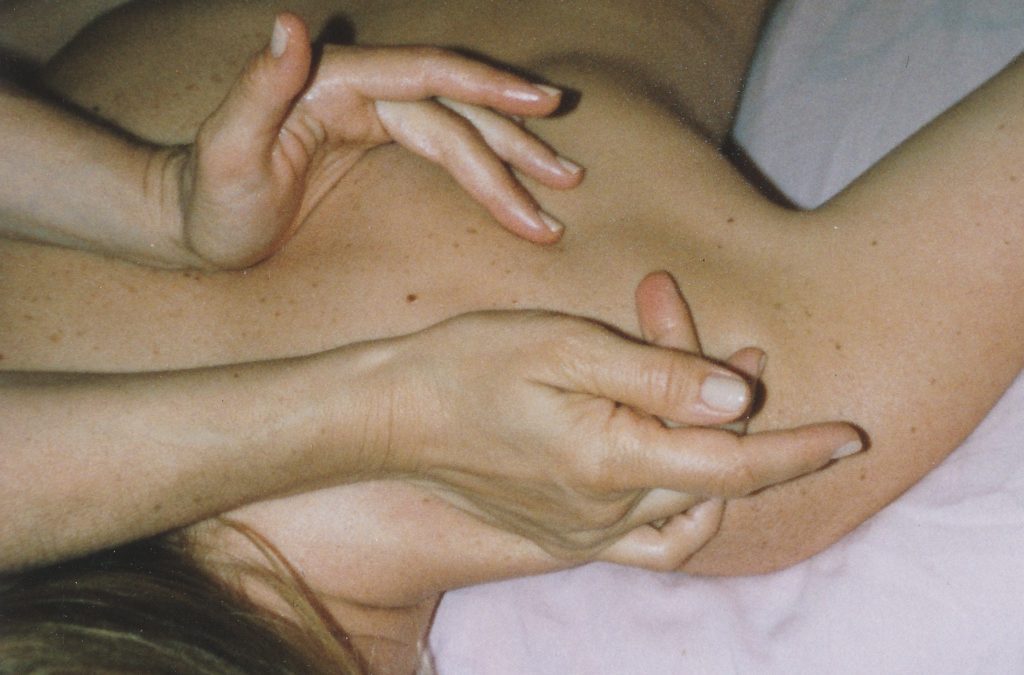
In addition, when we don’t release emotions and stuck energy we compromise our lymphatic system, the organs and tissues that fight infection and rid the body of toxins. This is why bodywork is so important and why I myself prioritize receiving massage nearly every week in my stage of life.
A lack of movement also affects our endocrine system, the network of glands that produces and moves hormones to specific tissues and organs in teh body. When we get blocked in the adrenal glands, for example, we stay stuck in fear, anger, judgement, and disappointment. we struggle to access smiles, laughter, and love that can remove the block.
Forgiveness allows life to move again while grudges keep it stuck.
Pg 54 I never taught my children to stop wiggling. Wiggling is good for us—it indicates that life is happening around and through us. It moves our lymph, lubricates our joints and keeps our muscles from getting tight.
When we feel joy in our body, wiggling, walking and moving around are natural responses. the inverse is also true: wiggling, walking, and moving around can help us to feel more joyful. a brisk walk is incredibly helpful for the brain which does’t like to sit still either.
Pg 55 this concept of energy flow has been studied for millennia in the East, on an even subtler scale. Traditional Chinese medicine is based on an understanding of energy flow that runs to and from specific organs through meridians, or energy channels that run through the body. Treatments such as acupuncture acupressure and moxibustion are applied to key points on these meridians to unblock them, activate them, and help the energy flow.
Pg 62 We have to get moving to access resources—we have to awaken our life force in order to ask for help.
Pg 85 Let things go and realign with life.
Pg 85 Practice: Letting Go exercise:
1) This exercise will work best if you get up and MOVE!. Put on some upbeat music and start walking around your house or neighborhood. Let your body move loosely and freely as you walk—you may even dance a little.
2) As you move your body, consider something that feels stuck in your life. Feel that sense of stockiness in your whole body.
3) Imagine you can hold this stuck thing in your hand. Squeeze your hand.
4) While still moving hold your hand out in front of you, pal up, with the fingers together. Then drop it down and back opening the fingers slightly. Let the weight of your arm bring your hand down; let life move itself. Release the stickiness like flowers to the water. Really let it go. You can think or say words that are meaningful to you – “It doesn’t matter” or any similar phrase that works for you.
5) Once you’ve let it go, take a moment to appreciate the flow of life moving through you. this is your life force. Honor and cherish it; it will be with you your whole life.
Love & Fear, Light and Dark
Pg 92 …how love and fear work. Love dispels fear, but it is also blocked by fear. They’re constantly in a push-pull game together. If fear is our habit, practicing love is a wise solution. And that practice will take us far, because love is infinitely stronger than fear—always! Just as our bodies are born to breathe air, we are born to love. Any effort we put toward love—truly any effort at all—will self-perpetuate, bringing joy, health, and well-being into our lives.
Pg 93 No matter how much darkness there is, light overcomes it. Light spreads through the entire space. the darkness can’t persist in the presence of something as powerful as that.
Pg 103 Imagery concentrates our thoughts and makes them real in our bodies. As new research emerges around stem cells, which I see as science’s answer to the creative life force, it appears that they are affected by how and what we think. Studies are affirming what holistic, spiritual and often Indigenous healers have been saying for centuries: there’s over in reorganizing our own role in the healing process because our minds affect everything, right down to the cellular level.
Pg 117 We don’t have to wait until we’re suffering to start offering ourselves love as medicine.
Pg 117 Practice: Loving Yourself into Healing exercise:
1) Get quiet and allow a complaint to rise to the surface.
2) Wait for an image emerges to encapsulate it. Take a moment to really look at it. What shapes, colors, textures arise?
3) Ask the image: What do you have other show me? What do you need?
4) See your image wrapped in love, held in the unconditional loving embrace of the entire universe. Hear the angels singing once again, just as they did the day your were born. Thank the image and allow it to fade away.
5) Time for a hug. Give yourself a good Hug.
6) While hugging yourself, check in with your heart. Assess where it is today—how lovable, and love-able do you feel? Receive the answer without judgement. You can repeat this gesture, hugging yourself, anytime you want to assess how love is flowing through you.
Community
Pg 124 Connecting with community amplifies our individual life force by realigning it with the collective life force.
This means that we thrive when we receive others’ attempts to connect with us. And since connection is something we offer as well as accept, we are the ones who determine the health of our communities. Each of us is responsible for creating a supportive network for ourselves. In doing so, we contribute to the overall network that supports others.
It doesn’t take perfect people or a lot of money to help a group thrive; it takes working with what we have and finding a way for that to be enough.
I prioritize my social relationships because I know how it feels through my whole being when I’m giving to and receiving from others.
Pg 128 We often don’t interact with one another because we don’t want to get our hands dirty. We don’t wan tto deal with what we perceive to be others’ deficits. We want to protect ourselves so we can’t be disappointed. But in the process, we miss out on life.
The more we progress, the more it seems that we simply want the convenience of not having to ask anything of our neighbors and friends. We’re constructing a community-for-hire.
Gone are the days of borrowing a cup of sugar, let alone raising a barn with neighbors.
Pg 129 We need to borrow cups of sugar. We benefit from barn raising. Living together this way forces us to connect, even in small ways. In the past, our messy, frequent interactions made sure we knew our neighbors and understood what was happening in one another’s lives. They kept us vital by providing a safeguard against isolation.
When we don’t connect with community we miss out on a fundamental piece of being human.
Pg 130 Our paths can and will intersect with the paths of others. A little stress may have positive benefits.
Pg 155 Practice: Weaving Together the Fabric of Life exercise:
1) Think about your friends, coworkers, family, and neighbors—the people you see ostensibly in your life. Let yourself wonder: In what ways is my community working? In what ways is it not working? Do you feel a sense of connection? Do you rely on one another?
2) Start remembering times when you have felt truly supported by your community. Let yourself remember how it felt.
3) Recall times in the past when you offered your time or support to others. Remember how it felt to see their smile.
4) Ask Yourself: What relationships need my love and tending? You can think of your love as concentric circles that radiate out from your heart. Whom can you call or connect with? Whom can you forgive? Which relationships deserve better boundaries? How can you find a friend within everyone—even someone you don’t like? How can yo enrich your relationships and weave the fabric of life together more tightly?
5) Weave the fingers of your hands together in front of you and remember that your love is your deepest prayer and truest expression of your life. Allow your hands to feel connected and supported. You can weave your fingers together like this whenever you need to remind yourself of the love of those around you.
Life Lessons
Pg 161 Everything is your teacher. When we look for the lessons, we move our attention away form our suffering and direct it back towards life. Everything in life becomes a teacher. Seeing everything this way helps us make our life a living, breathing, process. It calls us to engage and interact with everything—absolutely everything— that appears on our path.
Pg 169 As adults we need to demonstrate through our own growth how to redirect our energy back toward life after a period of pain.
Redirecting energy like this is a choice that requires us to bring our very highest selves forward—especially when things are hard. It helps us to reengage with the world around us, give us the best of ourselves, and receive the best in return.
Pg 191 Practice: Finding the Teaching exercise:
This exercise isn’t always easy. It’s something we practice over and over again in the hope that we may someday succeed in it. Be gentle and kind with yourself, always.
1) Think back to an event that taught you a lot in your life. (start with a comfortable memory not a hard lesson at first). Choose something that doesn’t activate a strong emotional reaction.
2) Let your mind run through the lessons you learned from that event and the positive things that came from it. Really feel it’s positivity; let it pour over you like sunlight. You’re gathering strength for the next part of the exercise, so allow yourself to bathe in the positivity first.
3) When you’re ready, allow your mind to wander to something that is hard in your life right now. It may be related to physical health, emotions, relationships, finances, the world around you, or anything else. Pick something tough—something that feels unfair or undeserved.
4) Consider this difficult thing from all angles. Ask yourself: What could this mean for my soul on a larger scale? What could I be learning here? What wisdom could I get from this extremely challenging experience? How could it shift my relationship with the past, the future or my life today? What could it be here to teach me? Imagine yourself years from now looking back on this challenge—-what you might have learned from it and even how it may have helped you grow and change, leading to a richer life. Though at times it’s hard to push through pain or distress, try, as there are gifts in teh pain.
5) Ask for a dream to help show you what you aren’t seeing. Go to sleep, let your subconscious inform the process, and proceed to step 6 once your dream has arrived. Record your dream as soon as you wake up so you get all the details—even the ones that don’t make sense.
6) Consider what yo recorded about your dream. How might you interpret it? How might the different characters locations, phrases, actions and or events from the dream help you to understand your challenge?
7) Send gratitude to the answers. Even one small part that is positive is a miracle. No matter how insignificant it may seem, be grateful for any lesson you find, and be grateful, to yourself for being brave enough to seek it out.
8) Place your hands together palms touching thumbs against your heart. Universal symbol of gratitude. We are bowing to life as our teacher.
Spending Our Energy
Pg 198 Spend your energy wisely. When we align our energy with life, we create a give-and-take, sharing relationship with the source.
Pg 199 When we get locked up in fear and stop using the energy we have, we block not only the life force moving out from ourselves and into the world but the life force that’s meant to come back to us.
Pg 200 We need to ask ourselves: What do I have enough of? What can I spare? What can I give in order to receive? What did I put into my account lately?
Pg 203 My mother smiled up from her hospital bed. She did that because she understood something important: as long as she still had energy left, it was up to her to keep spending it on what brought her joy. Seeing us looking down on her laughing was worth it.
Spending our energy on what we love is important. It helps us turn toward life and receive the energy that is waiting for us.Each of us has to find the rhythm that works for us and adapt to it as it shifts and changes.
Life’s flow is based on rhythm. Bodies have a rhythm: they’re born, they learn a series of lessons, and then every single one of them dies.
Rest is a natural part of the rhythm of life. And an important part of healing too.
Pg 204 While resting we’re meant to think kind, gentle thoughts about our body. We’re meant to nourish ourselves, enjoying a slower pace and being fully present to what is. True rest honors our body and our soul’s greater mission within our incarnation. Rejuvenating ourselves in this way enables us to give life our “all.”
It’s sometimes in the moments when we feel we’re about to run out of something completely that it comes back to us.
Pg 206 Sometimes we have to get down to the bare bones to get something in return—and it’s only when we do this, really giving all we’ve got, that life starts to send energy back to us.
Taking a measured risk. Certain risks are necessary to a well-lived life. If we aren’t willing to risk our energy, we start to guard it. We disconnect from our own wildness. No mater how careful we are, we end up risking and losing everything to fear.
So how can we know which risks are worth taking? When is it worth spending our energy in the hope that it’s an investment that will bring us more in return.
Pg 207 The answers to these questions are often individual, because they have everything to do with the precise blueprint of each person’s soul. We never know what tragedies or miracles will befall us. Each of us experiences incredible events in our lives, every one of them part of our soul’s journey. I’ve guided yo uto understand who yo uare and what you came here to do, so you can contact the physician within and answer many of your own questions.
SECRETS SHARED
Certain things are never worth anyone’s energy; lamenting the past, digging into self-pity, and feeding negativity are rarely useful and then only when they help us change our present and future.
Things that give you juice are always worth your energy.
If something feels stagnant, put your energy toward what is moving. Don’t waste your energy on what is stuck.
Love is always worth your energy. Always. Lean into what you love, whose you love, how you love. Love is an endless font of life force and it’s always here for you.
Good community is worth your energy too.
Looking for the lessons in everything guides our energy.
Pg 209 We’re meant to interact with our lives. The work of life is simple: we must try and fail until we succeed.
Pg 219 Practice: Embracing Your Life exercise
1) Consider the activities, people, and places you’ve put energy into throughout your life. What has drained your energy? Where can you invest your energy and receive a return?
2) Feel. Wander over those same activities, people, and places in your life, but this time feel them. Does your energy flow freely or shrink back? Do you feel an increase or decrease in your life force? What does your deepest knowing tell you?
3) From #2 consciously pick one activity, person, or place that brings you more energy. How could you invite more of that into your life? Find one small shift you could make and move toward it.
4) Consider the people, places, and activities that drain your energy . Look for at least one thing you could just stop doing completely. Pick something small to start. What would it take to just give it up? could you do it with gratitude and love?
5) Consider the things that are draining your energy but that you don’t want or aren’t able to release. How can you change the way you spend your life force? Can you change the way you r think about that person, can you adjust the way you spend time in that place, or can you shift the type of energy you put into that activity?
6) Open you r arms wide and imagine yourself embracing the force of life. Feel life’s boundless energy moving out from your heart and through your fingertips. Embrace your life in all of its joys and sorrows, challenges and learnings., triumphs and surprises, and be glad that you have been given the p precious gift of life. Practice first thing in the morning or before going to bed, allowing yourself to embrace the wildness of life all around you.